
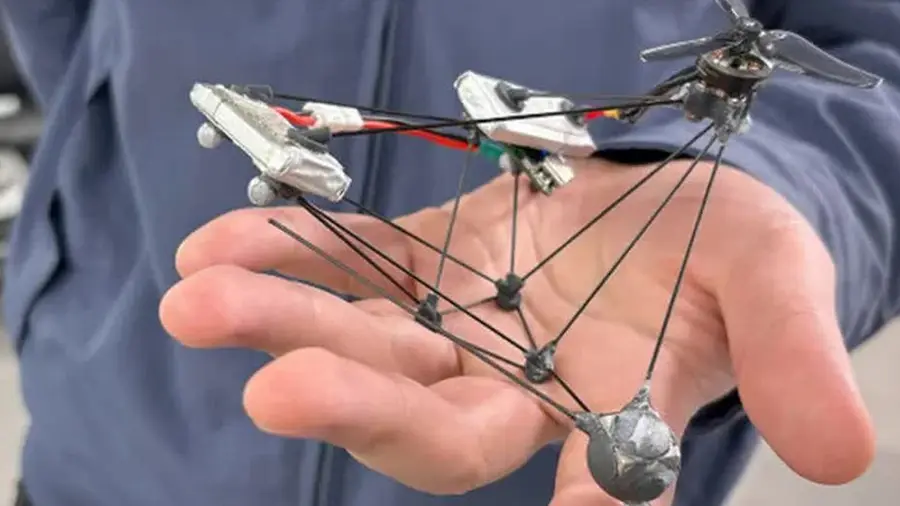
Researchers at Northwestern University have unveiled a groundbreaking prototype of a drone that can seemingly vanish from human sight. Unlike conventional drones that rely on camouflage or transparent materials, this new device employs a unique method to achieve its elusive quality.
Introducing the Phantom Twist
The drone, dubbed Phantom Twist, utilizes the phenomenon of motion blur by rotating its entire body at an impressive rate of up to 25 times per second. At this velocity, the human eye struggles to discern the drone’s shape, making it appear as just a vague shadow.
Innovative Design and Functionality
In contrast to traditional drones equipped with four propellers, Phantom Twist features a single motor and propeller. As the propeller spins in one direction, the body of the drone rotates in the opposite direction. This clever maneuvering creates an optical illusion, helping the drone evade detection.
The research team discovered that at rotation speeds between 15 and 25 times per second, human vision tends to merge moving objects with their backgrounds. This effect contributes to the drone’s nearly invisible appearance.
Advanced Computational Modeling
To craft this innovative drone, researchers utilized computational models that generated approximately 20,000 design configurations. They then implemented artificial intelligence algorithms to optimize the placement of various components, including the motor, battery, circuit board, and stabilizers, ensuring an ideal balance between flight capabilities and minimal visibility.
Through extensive simulations against 100 different real-world backgrounds, the team evaluated how easily each design could be recognized by a vision system mimicking human perception. From this rigorous process, they narrowed down to 500 designs with the lowest visibility before finalizing the Phantom Twist.
Challenges and Future Developments
While the prototype has shown remarkable potential, it is not without limitations. Currently, the Phantom Twist operates within controlled environments, and some components, such as carbon fiber support rods and cables, remain visible. Additionally, the sound of the propeller is audible, even if the drone's shape is difficult to detect.
Looking ahead, researchers aim to develop a quieter version of the drone, utilizing more transparent materials to enhance its disappearing effect. They believe this technology holds promise for various applications, including wildlife observation without disturbing natural habitats. Furthermore, the rotating camera on the drone can provide a 360-degree view to assist with navigation.
Previous advancements in drone technology include a mosquito-sized surveillance drone from China and Harvard's solar-powered RoboBee, demonstrating the ongoing innovation in this field.
Source: https://tekno.kompas.com/read/2026/07/29/19010047/peneliti-bikin-drone-yang-bisa-menghilang-dari-pandangan